
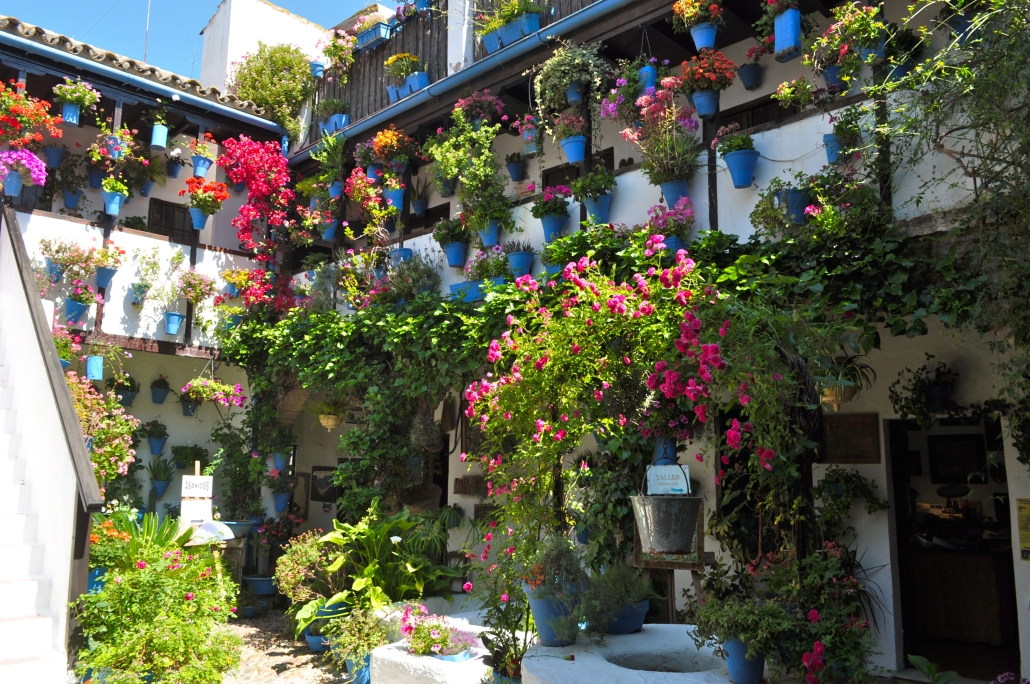
Traditional Andalucia courtyard. Image: Lucia LaRoche
COP28 Report from Pablo LaRoche:
The temperature inside our buildings affects our health, productivity, and overall well-being. But as our planet continues to heat up, we are increasing our reliance on cooling technologies, warming our planet even more. Furthermore, when buildings are not properly designed for the climate, operating expenses make cooling inaccessible to many. The themes of health, relief, recovery, and peace in COP 28 address these issues, aiming to boost policies and investments that protect lives and livelihoods and support community resilience and stability by implementing strategies to improve human health that also mitigate our impact on climate change.
A closed building is like a car left under the scorching sun. As it absorbs solar energy, it heats up, typically requiring air conditioning for cooling. This generates emissions through electricity usage (operational emissions), the potential refrigerant release (direct emissions), and the environmental impact of manufacturing the cooling device (embodied emissions). However, cooling is necessary, and buildings that are not adapted to a warmer climate will have a harmful and even deadly impact on the occupants, especially on the poor and the elderly.
It is important to continuously improve the performance of mechanical cooling systems. However, there is also wisdom in simpler, locally rooted technologies. Preindustrial builders learned to improve building cooling by developing passive systems that collaborated with nature. Indigenous technology and vernacular architecture teach us valuable lessons about passive cooling. A passively cooled building will work like an air conditioner and harness natural forces. The building’s materials and design transfer heat to thermal sinks, such as the air around the building, in the same way air conditioning does, but without using electricity. Passive cooling systems reduce the need for mechanical cooling while also increasing building resilience, helping occupants survive extreme weather trends or grid failures. It is possible to improve the performance of passive systems by adding smart controllers that monitor conditions in real-time to adjust the operation of the passive system and maintain indoor temperatures within specified parameters, providing an alternative to mechanical cooling systems.
To have any real impact, these strategies should be implemented in all buildings, including existing informal settlements, providing thermal comfort with minimum emissions. The community should also participate in the design process and design excellence is important. Buildings that are appreciated and easy to operate by their occupants will perform better on a warming planet.
Even though the building sector is responsible for at least 40% of all emissions, it has received very little climate-focused funding compared to other sectors. We must invest more in research to reduce the GHG emissions from the construction and operation of our buildings. Educating architecture and engineering students is also critical to creating an environment that will help us limit warming below the 2-degree threshold.
All countries should include built environment strategies in the nationally determined contributions and to reach their carbon reduction goals, buildings should be low carbon while also resilient and designed for passive survivability. Climate-related natural disasters will only increase in frequency and intensity, and we cannot continue living in buildings that are uninhabitable without outside energy.
Resilient comfort must now be recognized as not merely being about energy-efficient machines. It is about enabling people to remain comfortable indoors and outdoors as the climate warms and to survive in buildings during thermal extremes, even when energy systems fail. Buildings should then be designed so people can live and work comfortably in them while operating passively for as much of the year as possible, radically reducing local and global greenhouse gas emissions that are driving climate change while being more resilient.
There is much to do. And there is little time.
Pablo LaRoche is Principal and Director of Sustainable Design Services, Arcadis, and a professor of architecture at Cal Poly Pomono, where he is also Interim Director of the Lyle Center for Regnererative Studies.
