Published on: September 29, 2026

For the last decade, discussions about building embodied carbon and decarbonization have focused primarily on structure and enclosure. That work has advanced our industry tremendously, but it has also highlighted a significant blind spot: the embodied carbon associated with building systems.
Today, MEP systems can represent a substantial share of a building’s whole life carbon emissions. Yet until recently, our industry lacked the data, benchmarks, and common methodologies needed to understand where emissions occur and how to reduce them. As a result, many practitioners have wanted to act but have not had the tools to do so with confidence.
MEP 2040 was created to change that.
What makes this initiative important is not just the data it produces, but the foundation it creates for collective action. By bringing firms together to measure embodied carbon consistently, share project data openly, establish benchmarks, and learn from one another, MEP 2040 is helping build the knowledge base our profession needs to accelerate decarbonization of building systems.
This work depends on something larger than any individual project or organization. It depends on collaboration, transparency, and a shared commitment to progress. The findings presented in the MEP 2040 Whole Life Carbon Pilot Findings + Gap Analysis represent not only an important milestone, but also the beginning of a broader industry effort to understand and reduce the carbon impacts of MEP systems.
We are pleased to share this work through BEACON and to recognize the growing community of practitioners contributing their time, expertise, and project data to this effort. Together, they are creating the evidence, capacity, and momentum needed to move our industry from ambition to implementation.


MEP 2040 Whole Life Carbon Pilot Findings + Gap Analysis
MEP 2040 launched its Whole Life Carbon Pilot in February 2025 to close an industry gap in detailed, project-specific MEP quantity takeoffs and embodied carbon measurements, drawing on nineteen real project case studies contributed by Signatory firms. As a result, MEP 2040 just released the findings in the Whole Life Carbon Pilot Findings + Gap Analysis, and the takeaway is clear: MEP systems are not a secondary consideration in building decarbonization. Across reported projects, MEP embodied carbon was comparable in magnitude to typical structure, enclosure, and interiors (SEI) impacts, reinforcing that MEP systems should be evaluated alongside SEI in any whole-building life cycle assessment. In many cases, when operational carbon and fugitive refrigerant emissions are included, the impacts associated with MEP systems exceed those of SEI, making them a critical consideration in any credible decarbonization strategy.
Acting as an early industry dataset for understanding the carbon impacts of mechanical, electrical, plumbing, and related building systems across a full building life cycle, additional findings from the report include wide variability in operational and fugitive refrigerant emissions, significant replacement (B4) impacts over the building life cycle, and the outsized influence of categories including mechanical equipment, piping, ductwork, electrical equipment, and, where present, photovoltaic and geothermal systems.
The report also maps the gaps that remain in component scope, carbon data, reporting consistency, refrigerant leakage assumptions and the availability of robust industry benchmark datasets. Closing those gaps will require continued collaboration across the AEC industry.
The pilot and report were produced by the dedicated members of the MEP 2040 Data Analysis and Reporting Working Group, representing signatory firms from across the industry who volunteered their time, expertise and project data to build a shared understanding of MEP whole-life carbon impacts and advance collective action toward building decarbonization.


What’s Next for the CARE Tool
The CARE Tool is the first tool to allow users to estimate and compare the embodied, operating, and avoided carbon impacts of reusing and upgrading an existing building or replacing it with new construction, and teams across North America are using CARE to make the case for building reuse on real projects.
This winter the CARE team is excited to release significant expansions to the tool, including new features at the building scale that allow users to generate and dynamically compare multiple reuse and new construction scenarios side by side, and then save and share their work.
The same release will introduce CARE for Portfolios, which scales that side-by-side comparison from a single building to an entire portfolio so that owners and planners can build and dynamically compare whole-portfolio scenarios over time, and pinpoint where strategic reuse delivers the greatest emissions reductions.
Stay tuned for more this winter.
Architecture 2030 at COP31
Architecture 2030 heads to Antalya, Türkiye this November for COP31, where we continue to elevate the built environment on the largest stage in global climate policy. We bring a theme to every COP, chosen for what the sector most needs to elevate in that moment. Recent years have centered sufficiency, circularity, and the reuse of existing and traditional buildings, and we will continue to champion each of these priorities. This year we are expanding our themes to include infrastructure. Our delegation, led by Senior Fellow Yasemin Kologlu, HKS, will co-host the official UNFCCC side event Three-Quarters Unbuilt: Decarbonizing Infrastructure for 1.5°C with Global Infrastructure Basel (GIB) and the Royal Institution of Chartered Surveyors (RICS).
Three-quarters of the infrastructure that will exist in 2050 has yet to be built, and cement, iron, steel, and aluminum for infrastructure alone account for 7.3% of annual global CO2 emissions. Unlike operating emissions, which can be reduced over the life of an asset, embodied emissions are locked in on day one of operation. Meeting 1.5°C requires eliminating CO2 emissions from infrastructure by 2040, and our side event will make the case for the industry commitments, aligned measurement, and certification systems that can close that distance.

Stay informed and inspired with recent articles and resources by Architecture 2030 and our multidisciplinary network of thought leaders. Dive in and explore the latest insights.
ARTICLES

AI image generated by Edward Mazria
By Architecture 2030 Founder Edward Mazria — on how distorted statistics and outdated code comparisons are being used to dismantle standards that have saved Americans $3.48 trillion in energy costs since 2005.
ARCHITECT, July 2026

AI image generated by Edward Mazria
By Architecture 2030 Founder Edward Mazria — a case for siting hyperscale data centers on retired coal plants and industrial land rather than farmland and forest, and a blueprint for digital infrastructure that supports decarbonization, environmental cleanup, grid stability, and community revitalization.
ARCHITECT, Carbon Positive, June 2026
TOOLS & RESOURCES

The ECHO Project has released pilot guidance for conducting fair comparative project life cycle assessments, so that embodied carbon programs and policies can adopt a consistent approach to baseline modeling. The guidance walks through establishing functional equivalency between baseline and proposed projects, identifies acceptable embodied carbon reduction strategies, and provides direction on developing baselines. It covers buildings, and begins to address sites and infrastructure. The intent is to remove uncertainty when performing or reviewing a comparative project LCA, and to build confidence in the results.
ECHO is seeking practitioner feedback through the end of June 2027. Send input to mlambert@carbonleadershipforum.org.
ECHO Project, September 2026
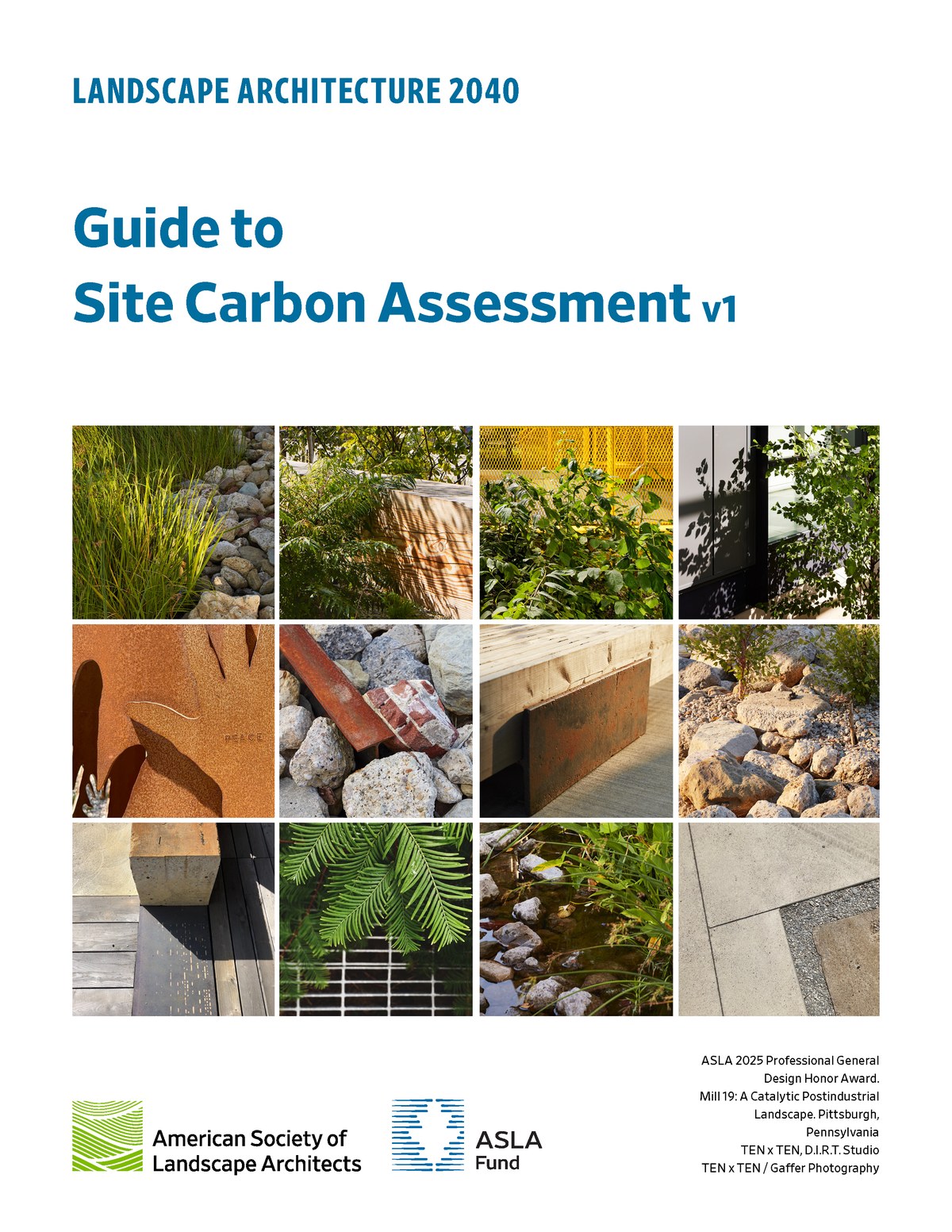
The American Society of Landscape Architects has released the first standardized methodology for measuring the embodied, operational, and stored carbon of site projects, giving landscape architects a consistent way to document both what a site emits and what it stores. The guide details a new life cycle phase, Landscape Carbon Storage (B9), for calculating the carbon held in existing and proposed trees, plants, and soils. It also aligns the profession with carbon assessment efforts in the fields of planning, architecture, and civil, mechanical, electrical, plumbing, and structural engineering, as established by the cross-disciplinary ECHO Project.
ASLA, September 2026
The American Planning Association and its Sustainable Communities Division have launched a Mini-Field Guide series aimed at shifting everyday planning practice towards stronger, more sustainable communities. The first issue covers natural infrastructure. Restored wetlands, urban forests, marshes, and dunes meet engineering goals like reducing flooding, lowering extreme heat, and strengthening resilience, while also delivering climate benefits, public health gains, and green jobs. Focused on trees and urban forests, the guide offers six policy strategies with supporting evidence and real-world examples from cities of every size. The strategies cover overlay zones, tree protection ordinances, comprehensive plan designations, dedicated green infrastructure funds, development incentives, and green street design standards.
APA Sustainable Communities Division, September 2026

hollywoodHUB, Portland, Oregon. Photo by PortlandAppraisalBlog, CC BY-SA 4.0, via Wikimedia Commons
Oregon’s Department of Environmental Quality is directing $25.6 million towards 940 new housing units built to a lower embodied carbon standard across nine communities, pairing an embodied carbon reduction requirement with affordability and unit-size requirements. The Carbon Leadership Forum developed the program’s embodied carbon criteria and provides technical assistance to project teams through 2029, making Oregon a working precedent for states connecting housing supply to materials policy.
Carbon Leadership Forum, August 2026

Empire State Plaza, Albany, New York. Photo by Tim Schapker, CC BY 2.0, via Wikimedia Commons
In June 2026 New York issued a pilot whole-building life cycle assessment methodology under Executive Order 22, asking state agencies to apply it on capital projects and report back on what works in practice. Agencies report through a standard LCA Reporting Form, and the results will shape how the state eventually sets embodied carbon limits for public construction.
New York State Office of General Services and the GreenNY Embodied Carbon Working Group, June 2026

The New York Embodied Carbon Working Group, more than 35 experts spanning architecture, engineering, construction, manufacturing, government, and academia, has released a statewide roadmap for cutting emissions from construction materials. Recommendations run from statutory statewide reduction targets to three compliance pathways in the building code, covering reuse of existing buildings and materials, low-carbon material substitution, and project-level whole building life cycle assessment.
The coalition behind the plan includes AIA New York, NRDC, and ASCE’s Infrastructure 2050.
New York Embodied Carbon Working Group, July 2026

Shape what’s next. Get involved with upcoming funding and engagement opportunities designed to accelerate action.

The Landscape Architecture Foundation is accepting applications for its 2027 Case Study Investigation program, which funds faculty-student research teams to work alongside practitioners quantifying the environmental, social, and economic performance of built projects. The program runs February through August 2027 and selects 5 to 10 research teams and 10 to 12 projects each year. Faculty and design firms apply as a partnership but submit separate applications, and a $15 application fee applies to each.
Application Deadline: November 1, 2026