
The Ellinikon Park / courtesy Sasaski
COP28 Report from Chris Hardy
Stepping Toward Decarbonization
By Chris Hardy
In 1995, at the time of the first UN Conference of the Parties (COP), I was 11 years old. I was unaware of the conference other than a chat with my mother. I remember my mother’s insistence that the world was heading toward a sustainable future, and that this would be a moral imperative for my generation.
I went on to study biology and environmental science and became aware of the COPs primarily through following the efforts of conservation biologists like Dr. Norman Myers and Dr. Stuart Pimm, and organizations like the World Commission on Protected Areas (WCPA). Urgency seemed to be building in the 2000s, with each year the COP serving as a platform to convince the world community of the reality of climate change.
By COP21, I had left the sciences and had found landscape architecture, being charmed by the agency and optimism of design. I designed and oversaw the construction of parks, gardens, and plazas around the world. I dove into LEED, New Urbanism, green infrastructure, eco-districts, and ecological restoration, learning from mentors and practice. With COP21, the 2015 Paris meeting that set the 1.5 degrees Celcius target limit for warming, it felt like our generation was finally moving forward with a collective commitment to a sustainable future.
Since then, I have learned from practice and research that how we build today can be conducted in a sensitive and high-performance way, but it will still come at a climate cost. As long as our construction sector is rooted in high-emissions materials and transportation methods, construction will be contributing to our climate crisis.
I have also learned about the real power and capacity of natural systems for drawing carbon dioxide down out of the atmosphere and locking it up in vegetation and soils. If we can marry our growing understanding of the emissions associated with construction with investment in large-scale restoration and soil management projects, we can begin to have climate-neutral projects. Restoration ecology and soil carbon management are important drawdown tactics we need in addition to decarbonization.
Since COP21, the building and landscape design and planning communities have invested in trying to understand the emissions associated with construction — and the potential for natural systems to store carbon, as well as using green infrastructure to replace potentially heavy emissions gray infrastructure systems. Now at COP28, our professionals have enough information to make climate-informed design decisions. City planners have access to tools and benchmark datasets to plan for the energy demands as well as potential embodied emissions of planned developments and infrastructure projects.
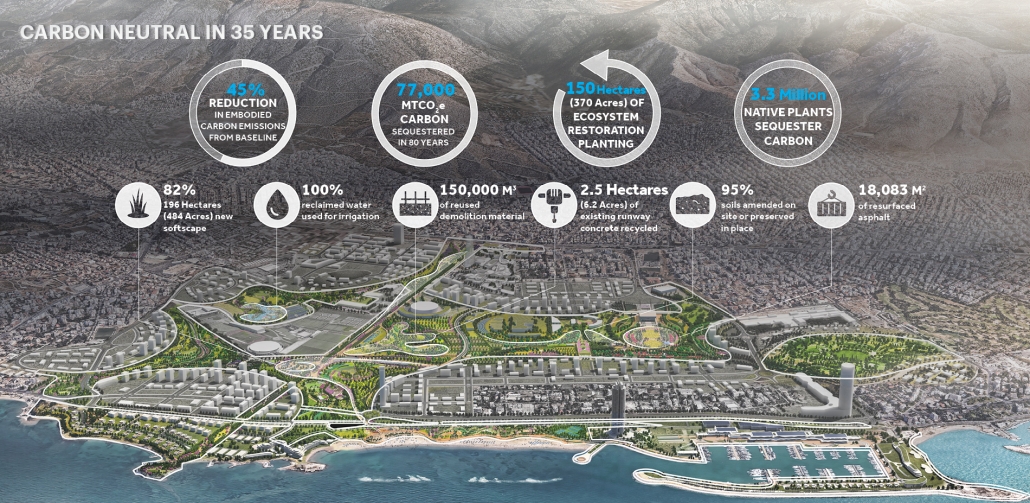
If you would like to see a case study of applying these lessons to a large-scale development and metropolitan park, please check out my team’s work in Athens, Greece. If you would like to learn more about how our team at Sasaki is addressing decarbonizing planning, please check out our white paper, and the associated application, “CarbonConscience,” here.
We have to challenge how we think about development, appreciating that every act of construction has emissions. We need governments and agencies to take ownership of our climate commons, and tackle construction emissions with the same urgency as transportation and energy sectors.
I hope that by COP35, all major cities around the world will be aware of and regulate their respective carbon-sheds with the same care, regulatory rigor, and attention as their water resources. I hope that understanding low-energy and low-carbon design is considered a basic competency in all design, engineering, and real estate professions. I hope that we are engaging in building and rebuilding our cities to be more livable, resilient, equitable, and adaptive to changing climates in a way that doesn’t add to the crisis. My greatest fear is that in our efforts to build our way out of this crisis, we feed it.
The COPs have been happening over the entirety of my adult and professional life. They have transitioned from convincing the world of the crisis, to negotiating targets, and now tracking and reporting on change over time. They serve as a forum for conversation, negotiation, and collaboration. It will be up to all of us, individuals, non-profits, and governments, to translate these aspirations into real change. Writing this after having put my own children to sleep, I think about their generation, which will no longer consider addressing climate change as an abstract moral imperative but an existential expectation. We have to get this right, and we have to do better each day until we decarbonize our society.
Chris Hardy is a landscape architect and Senior Associate at Sasaki.
