Published on: November 24, 2025
Dear Colleagues,
Landscape architecture is unique in the built environment in that it holds the potential to simultaneously address climate change and biodiversity loss. The sites and infrastructure we design can sequester carbon, promote biodiversity, and provide spaces for improved health and economic outcomes.
The impacts of our work extend well beyond climate- and biodiversity-positive designs, concurrently creating sustainable, multimodal, low-carbon communities where people can comfortably walk and bike to public amenities, use public transit, and minimize energy and waste. The nature-based solutions we design also support resiliency, mitigating stormwater, cooling urban spaces, improving air quality, and leading to increased human health outcomes.
Another unique aspect of our work is the ability of our designed sites and infrastructure to become climate positive over their service life; they can ultimately sequester more carbon than is released to produce the materials and products necessary for their construction and operation.
This issue of BEACON spotlights landscape architecture, demonstrating how these ideas can be put into action and highlighting tools and resources for use within the profession and beyond.


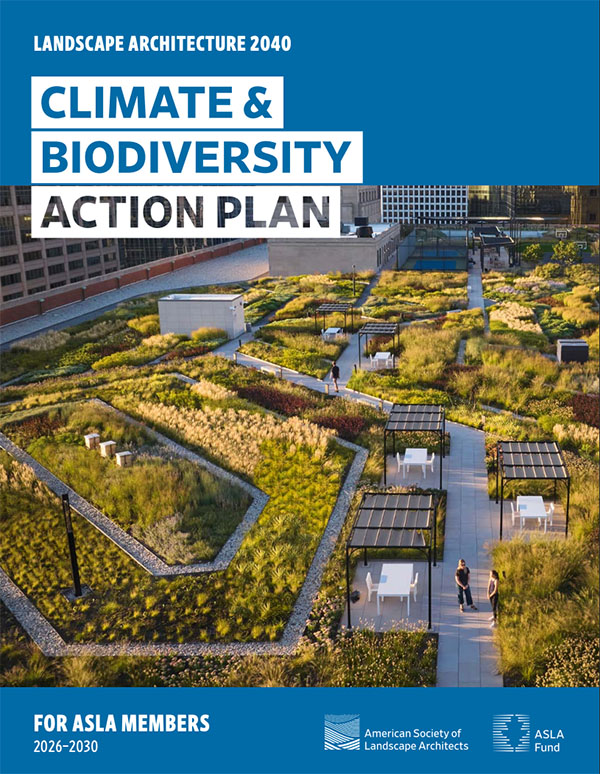
The American Society of Landscape Architects (ASLA) recently released its new Climate + Biodiversity Action Plan, Landscape Architecture 2040 (LA2040). The Plan is designed to empower the landscape architecture community to realize ASLA’s 2040 vision through four key lenses:
- Climate: Scale up climate positive approaches
- Biodiversity: Protect, conserve, restore, enhance, and manage
- Equity: Amplify the power of people and communities
- Advocacy: Advance climate and biodiversity action through leadership and engagement
LA2040 also sets important new targets, calling for all landscape architecture projects to, by 2040:
- Achieve zero greenhouse gas emissions and double carbon sequestration from business as usual.
- Protect, conserve, restore, enhance, and manage biodiversity.
- Provide significant economic benefits in the form of measurable ecosystem services, co-benefits, and livelihoods.
- Address climate and biodiversity injustices, amplify the power of communities, and increase the equitable distribution of climate and biodiversity investments.
The Plan is organized into two volumes – one for ASLA members, and one for ASLA and ASLA Chapters. Explore the plan and learn more here:


MEP 2040 Whole Life Carbon Pilot
In February 2025, MEP 2040 launched its MEP Whole Life Carbon Pilot program to address the lack of detailed, project-specific MEP quantity takeoffs and embodied carbon measurements. Leveraging the Beginner’s Guide to MEP Embodied Carbon, the initiative aims to fill this gap and advance industry practices.
Twenty-seven signatory firms contributed projects to the pilot, and the Data Analysis and Reporting group is currently conducting a gap analysis and preparing a findings report, which will be released in early 2026.
Stay tuned for the report, and for more information or to conduct your own pilot analysis, please reach out to Rachel Wrublik.
CARE 2.0
Since its launch in 2022, Architecture 2030’s CARE Tool has been used widely by building sector professionals and owners across North America to compare the carbon footprint of retrofitting an existing building to constructing a new one. Now, we’re excited to announce its next evolution.
In early 2026, we will launch CARE 2.0, a pivotal update that will enable users to create accounts, save projects, and—most powerfully—generate, save, and dynamically compare multiple retrofit and new construction scenarios side-by-side. CARE 2.0 is a critical milestone that paves the way for CARE for Portfolios, an exciting CARE Tool expansion planned for Winter 2026 that will enable analysis of entire building portfolios.
Stay tuned for CARE 2.0, and don’t hesitate to reach out to the CARE Team with any questions.

Stay informed and inspired with recent articles and resources by Architecture 2030 and our multidisciplinary network of thought leaders. Dive in and explore the latest insights:
ARTICLES

By Sarah Franklin and Lori Ferriss
World Economic Forum, November 2025

By Erin McDade with Meg Calkins
ARCHITECT, October 2025
By Edward Mazria
ARCHITECT, August 2025

By Chris Hardy
Common Edge, August 2025

By Anthony Flint, featuring Architecture 2030 Senior Fellow Lori Ferriss
Bloomberg, June 2025
TOOLS & RESOURCES
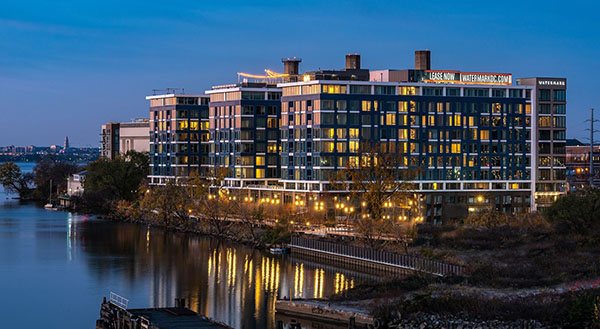
This recently-published report from ULI shares new evidence that commercial-to-residential conversion projects can deliver substantial carbon savings compared to leaving existing commercial spaces unrenovated and building new housing units.

Climate Positive Design’s Pathfinder tool is a free, web-based platform that helps landscape architects and designers calculate and reduce the carbon footprint of their projects, transforming them from carbon sources into carbon sinks.

This fourth edition report by the Carbon Leadership Forum delivers informed estimates across material categories – essential for procurement, modeling, and green building policies.

A collaborative report from the Carbon Leadership Forum, RMI, and the University of Washington Life Cycle Lab serving as a call to action, urging the industrial and construction sectors to continue progress towards global targets.

From the Carbon Leadership Forum, this collection of embodied carbon reduction case studies showcases built projects across a wide range of building types.

To slash building emissions, a new report from Builders for Climate Action identifies a key opportunity: regulating the embodied carbon of residential equipment in tandem with energy efficiency.

Shape what’s next. Get involved with upcoming funding and engagement opportunities designed to accelerate action:

Organization:
Landscape Architecture Foundation
Important Dates:
Applications due December 1, 2025
The $25,000 LAF Research Grant funds research projects relevant to the professional practice of landscape architecture. LAF is now accepting pre-proposals for the next grant cycle, with research to start in summer or fall of 2026.
Organization:
Landscape Architecture Foundation
Important Dates:
Applications due February 1, 2025
The $25,000 LAF Research Grant funds research projects relevant to the professional practice of landscape architecture. LAF is now accepting pre-proposals for the next grant cycle, with research to start in summer or fall of 2026.

Organization:
Heritage Now!
Heritage Now! – a campaign launched by the Decarbonizing the Built Environment through Heritage initiative – is calling for collaborators to join its global mission to harness the potential of built heritage for a resilient, climate positive and just future.