
COP29: Exterior Built Environment: the Immense Opportunity
November 2024
By Eustacia Brossart
We know by now, thanks in part to the efforts of Architecture 2030, that buildings are a major contributor to climate change. But did you know that much of the greenhouse gas (GHG) emissions from the built environment actually come from outside the building? Infrastructure and landscapes are significant, often overlooked sources of emissions. According to the United Nations Environment Programme, as of 2015, “75 percent of global urban infrastructure that will exist in 2050 has yet to be built.” This presents either a massive opportunity to reduce emissions and sequester carbon, cool cities, and preserve and enhance biodiversity and natural systems—or a risk of exacerbating these problems.
Like many designers, I became a landscape architect to try to make the world a little better. Much of my work has focused on helping cities adapt to climate change—sea level rise, drought, wildfires, and flooding. But several years ago, my colleague Pamela Conrad began questioning the carbon impacts of our projects, and realized that no tool existed for calculating the emissions and sequestration of landscape projects. So, we created a basic spreadsheet, and started examining the carbon footprints of various projects. We were shocked to discover that even fairly sustainably designed parks might take 15, 20, or even 50 years to offset their own emissions. Plazas and streetscapes could take 200 years or more. However, by reducing pavement and walls, choosing low-carbon materials, planting less turf lawn (which can be a net carbon emitter) and more trees and shrubs, and maintaining landscapes with integrated pest management and electric equipment, we could halve emissions and double sequestration.
At a global scale, we estimate that landscape projects can either continue to emit more carbon than they sequester or, through climate-positive design decisions, we can significantly contribute to the global drawdown of greenhouse gasses, biogenically sequestering a gigaton of CO₂ by 2050.
In 2019, we launched the Climate Positive Design Challenge and created the free, globally available Pathfinder tool to help designers measure and improve the carbon impact of their projects. Landscapes are complex and dynamic, and when cities are designed based on natural processes and the local environment, they can do much more than sequester carbon. In collaboration with Architecture 2030 and the ClimateWorks Foundation, we’ve recently expanded our resources, guidance and data to include information and metrics for biodiversity, cooling, water, and equity.
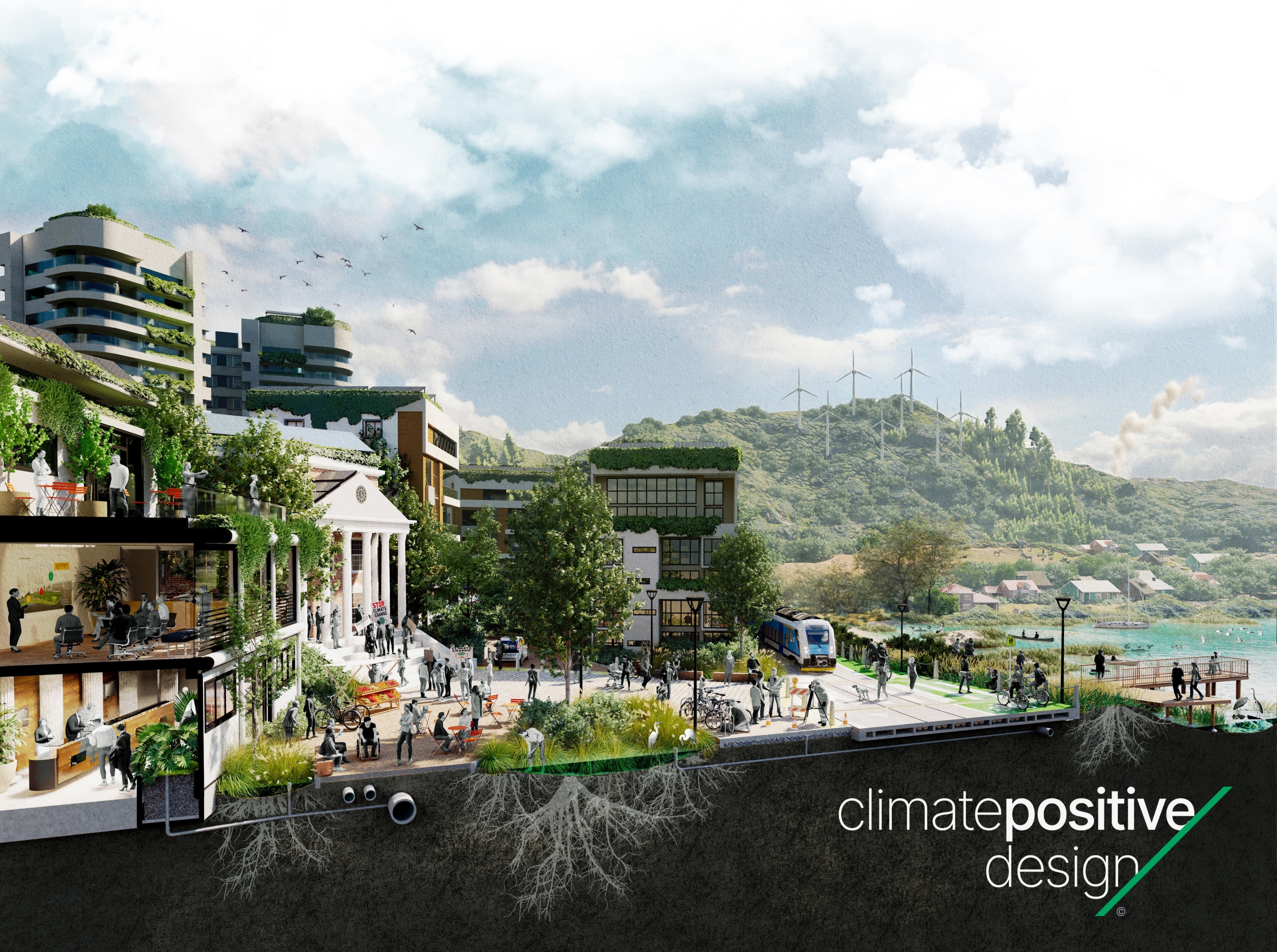
It’s time to move beyond concrete and lawn. Parks, streetscapes, medians, highways, levees, campuses, green roofs, plazas, private yards—much of the exterior built environment can be designed to mimic native habitats and connect to protected areas, thus providing habitat, improving biodiversity, and minimizing water demand. Underutilized spaces and degraded land can be planted with tiny forests that sequester carbon and cool cities. Vegetated swales and biotreatment areas can absorb and treat stormwater, greywater, and even blackwater. Living shorelines, vegetated riverbanks and floodplains can provide protection from sea level rise and flooding while reducing erosion and preserving soil. Regenerative agriculture can restore soil health, biodiversity, and animal welfare while improving yields.
Let’s start by protecting the habitats and natural areas we have left. As we continue to grow and develop, let’s work collectively to create climate-, biodiversity-, health-, and nature-positive cities for all people and species.
Virtual delegate to COP29, Eustacia Brossart is a landscape architect and research director at Climate Positive Design, where she develops climate- and biodiversity-positive resources for exterior built environment practitioners.


